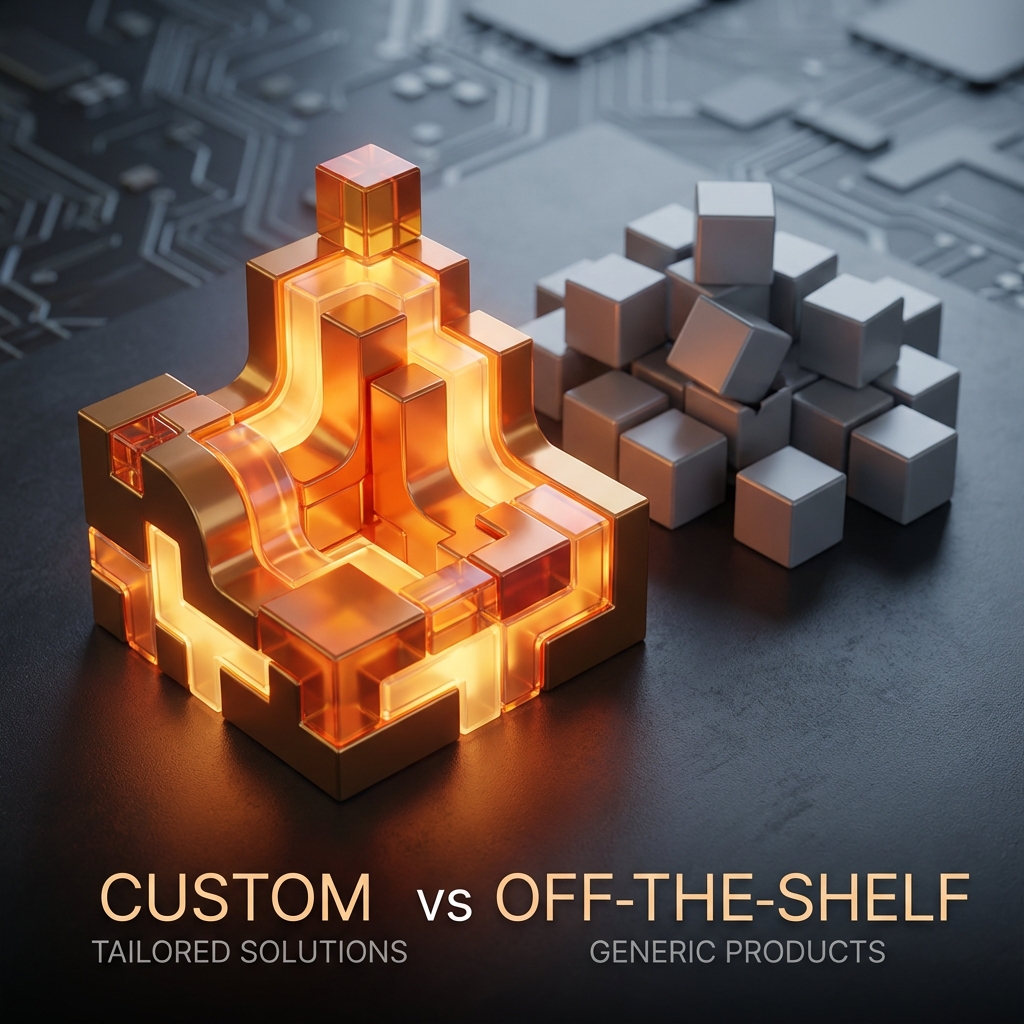
I have worked with over 50 businesses in the past 8 years. The ones that benefited most from custom software all shared one thing: they knew exactly what problem they needed to solve.
Custom software is not about having the latest technology. It is about solving real business problems that off-the-shelf tools cannot address.
Before you invest a penny, you need to know if custom software is the right answer for your situation. Let us look at the clear signs.
5 Clear Signs You Need Custom Software
You Are Spending Hours on Repetitive Tasks
If you or your team spend more than 5 hours per week on tasks that follow the same pattern every time — data entry, report generation, sending follow-up emails — you are losing money to inefficiency.
Example: Sarah runs a marketing agency. Her team spent 12 hours weekly compiling client reports. Custom automation reduced this to 30 minutes.
You Use 5+ Different Tools That Do Not Talk to Each Other
Jumping between spreadsheets, CRMs, email tools, and project management apps? Copying data from one place to another? This "swivel chair" integration is a massive time sink and error source.
Example: A logistics company used 7 separate systems. Their team spent 2 hours daily just syncing data. One integrated system eliminated this entirely.
Your Current Software Forces You to Work Around It
When you find yourself saying "the system does not let us do that" or creating manual workarounds for basic needs, your software is controlling your business instead of supporting it.
Example: A retailer could not track inventory the way they needed. They used spreadsheets alongside their $300/month ERP system.
You Are Turning Away Business Due to Capacity
If you could handle more clients, orders, or projects but your current processes cannot scale, you are literally leaving money on the table.
Example: A consultant could only handle 10 clients because onboarding took 8 hours each. Automation reduced onboarding to 1 hour, allowing 3x growth.
Your Competitors Are Moving Faster
If competitors are offering faster turnaround, lower prices, or better service because they have streamlined operations, you need to catch up or fall behind.
Example: A manufacturer watched competitors quote in hours while they took days. Custom software let them quote in minutes.
Quick Self-Assessment
Count how many of the 5 signs apply to your business:
Build vs Buy: Making the Right Choice
Here is a side-by-side comparison to help you think through the decision:
My Recommendation:
Start with off-the-shelf tools if they meet 80% of your needs. But when you find yourself working around your software more than working with it, it is time to consider custom. The productivity gains usually pay for the investment within 6-12 months.
Understanding the Investment
Let us talk numbers. Custom software typically costs between $10,000 and $100,000+ depending on complexity. That sounds like a lot, but consider the hidden costs of not investing:
The Real ROI Calculation
A $30,000 custom system that saves 20 hours per week at $50/hour pays for itself in 30 weeks. Everything after that is pure savings — plus the intangible benefits of happier employees and faster growth.
Your Next Steps
If you have identified with 2 or more of the signs above, here is what I recommend:
Document Your Pain Points
Write down the top 3 tasks that waste the most time or cause the most errors in your business.
Calculate the Cost
Estimate how much these problems cost you monthly in time, errors, and lost opportunities.
Talk to a Developer
A 30-minute conversation can clarify whether custom software makes sense for your situation.
Not Sure If Custom Software Is Right for You?
I offer free 30-minute consultations where we will discuss your specific situation and I will give you my honest assessment — no pressure, no obligation.
Book a Free Consultation